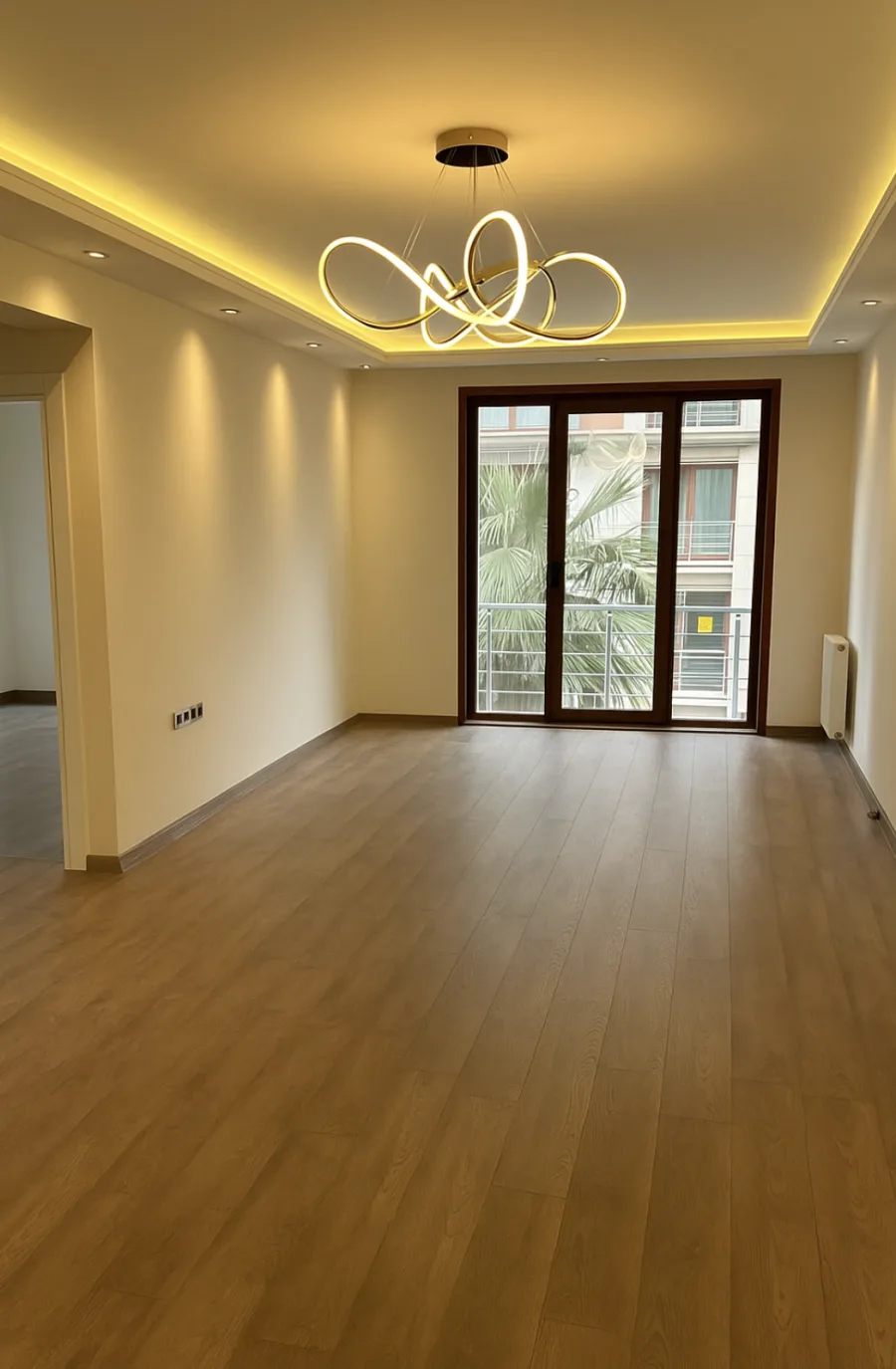
A room's character is largely shaped by its ceiling. A flat painted surface offers a neutral backdrop, but a well-designed LED gypsum board ceiling transforms the space entirely: it adds depth, layers light, and creates architectural rhythm. Across hundreds of residential and villa projects completed in Antalya, we have seen first-hand what the combination of gypsum ceilings and LED lighting can achieve. This guide covers gypsum ceiling types, cove indirect lighting techniques, LED strip selection criteria, track lighting systems, and smart control options.
Gypsum Board Ceiling Types
The market offers a wide range of suspended plasterboard ceiling designs. Choosing the right type directly determines both the aesthetic outcome and the lighting strategy.
- Flat dropped ceiling: The simplest and most economical option. A flat surface suspended 10–20 cm below the structural slab is an ideal canvas for recessed downlights and LED strips hidden behind a valance. Popular in Antalya villas for acoustic and thermal insulation.
- Stepped (multi-level) ceiling: Two or three height levels define different zones in a room. The lower tier above the seating area forms a natural architectural frame and creates a built-in cove channel for LED strips. This is the classic image that comes to mind when people say LED gypsum ceiling.
- Coffered ceiling: A grid of intersecting beams creating framed rectangular or square coffers. Each coffer can house an LED panel, a downlight cluster, or a decorative element. Delivers a classic, high-end architectural feel.
- Cove (curved coving) ceiling: The junction between the flat ceiling plane and the walls is curved or angled inward, forming a continuous niche. LED strips hidden inside wash the walls and ceiling with soft indirect light. Ideal for bedrooms, home cinemas, and lounge areas.
- Oval and custom forms: Circular medallions, elliptical frames, or free-form asymmetric shapes have become increasingly popular in entrance halls and living rooms. These are produced using CNC-routed plasterboard or curved carrier profiles.
- Moisture-resistant plasterboard: In bathrooms, kitchens, and areas adjacent to terraces, standard plasterboard must be replaced with green moisture-resistant boards or glass-fibre reinforced panels — essential in Antalya's coastal humidity.
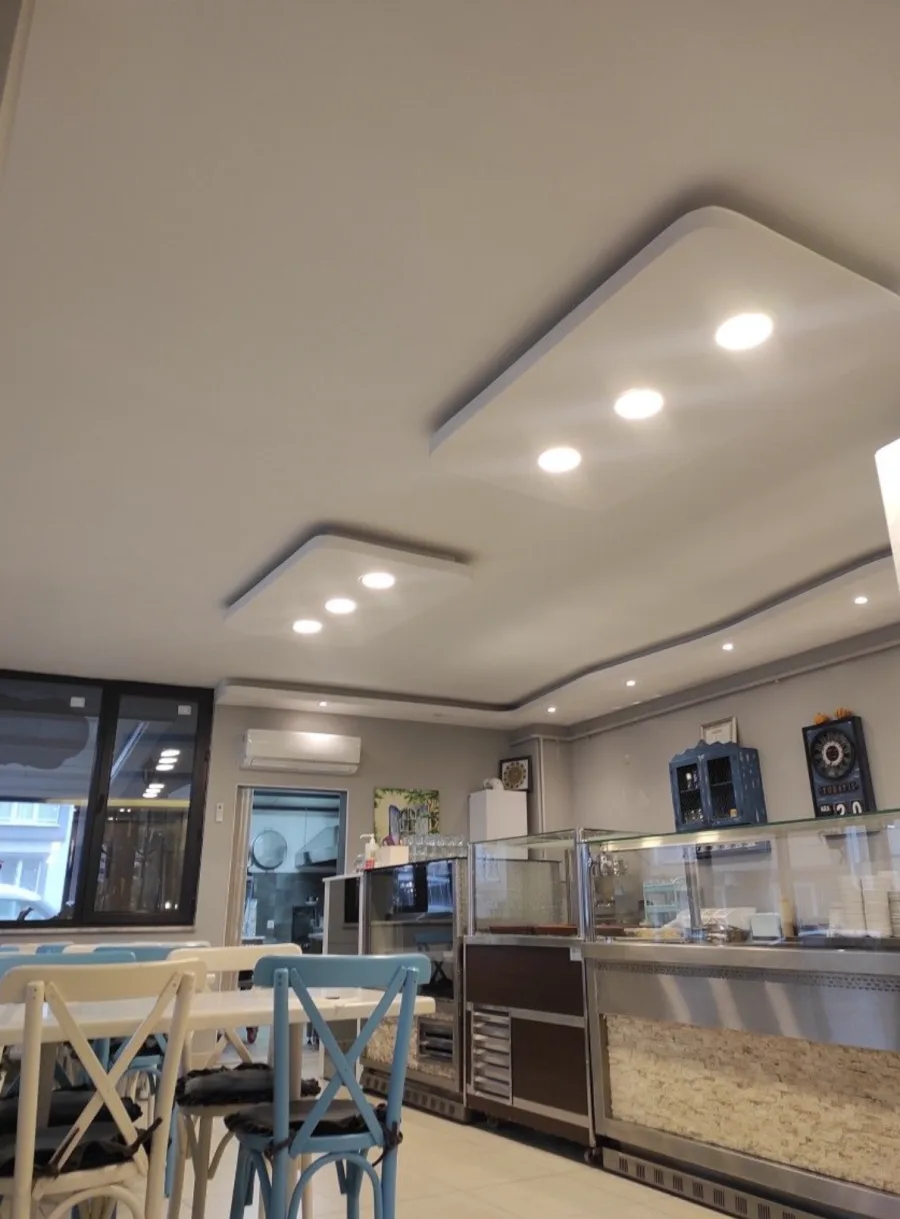 A rounded stepped gypsum ceiling with recessed downlights — a stylish and functional ceiling solution applicable to both commercial and residential spaces.
Cove Lighting: Indirect LED Light
Cove lighting is the technique of placing LED strips inside a niche so that light bounces off the ceiling or wall rather than shining directly into the eye. The result is a soft, shadow-free glow that wraps the room in atmosphere, adds visual volume, and reduces eye strain — particularly valuable in Antalya homes where strong Mediterranean daylight needs a contrasting evening mood.
Building the Cove Niche
- Stepped ceiling recess: The gap between the lower and upper tier of a stepped ceiling houses an aluminium L- or U-profile in which the LED strip sits. A minimum niche height of 5 cm ensures even light distribution across the ceiling surface above.
- Perimeter cove close to the wall: A plasterboard ledge set 15–25 cm from the wall directs light toward the wall surface, making the walls appear to glow softly from the inside — a look that opens up a space visually.
- Faux beam niche: Decorative beams with LED strips hidden inside their lower face deliver indirect downwash and reinforce the architectural character of the beam. Common in rustic, bohemian, and industrial-style projects.
Aluminium LED Profile Selection
Mounting an LED strip directly onto gypsum board without a profile concentrates heat and shortens the strip's lifespan. An aluminium profile acts as a heat sink, homogenises light output, and protects the strip. Key types:
- Recessed profile: Routed into the plasterboard surface; the ceiling appears flat. Best for minimal interiors.
- Surface-mount profile: Screwed directly to the surface; easier to install and available with clear, frosted, or opaque diffuser covers.
- Corner profile (45°): Placed at the wall-ceiling junction; distributes light equally to both surfaces.
LED Strip Technical Selection Guide
The market offers dozens of LED strip lighting options. The wrong choice leads to flickering, uneven illumination, or short service life. Key parameters to evaluate:
LED Chip Type
- SMD 2835: The most common chip; good lumen output at moderate cost. Standard choice for cove and decorative applications.
- SMD 5050: A tri-chip package offering higher output and full RGBW colour options. Preferred for colour-changing applications.
- COB (Chip On Board): Densely packed chips produce a continuous line of light with no hot spots between LEDs. The preferred choice for visible niches where dot-to-dot spacing would look uneven.
Colour Temperature (CCT)
- 2700K – Warm White: Amber-toned, intimate. Ideal for bedrooms, living rooms, and restaurants.
- 3000K – Soft White: Slightly brighter and more neutral than 2700K. The most popular choice for combined living and kitchen areas.
- 4000K – Neutral White: Close to natural daylight. Suited to home offices, kitchen worktops, and bathrooms.
- 6000K – Cool White / Daylight: Blue-toned and clinical. Best reserved for garages, utility rooms, and commercial spaces.
Tunable White (CCT-adjustable) LED strips allow the colour temperature to be shifted anywhere between 2700K and 6500K — enabling a single system to cover all daily lighting scenarios.
CRI (Colour Rendering Index)
CRI describes how accurately a light source renders an object's true colour. CRI 80+ is the minimum standard for residential use; CRI 90+ is recommended for kitchens, bathrooms, and art displays. Low-CRI strips make skin tones and food colours appear flat and unappealing.
Wattage and Lumen Calculation
A room's base illumination requires roughly 200–500 lm/m² depending on use. Cove lighting typically supplies half of that; recessed downlights or track lighting supply the rest. Always size the LED driver at 20% above total strip wattage: for a 40 W strip, select a 50 W driver.
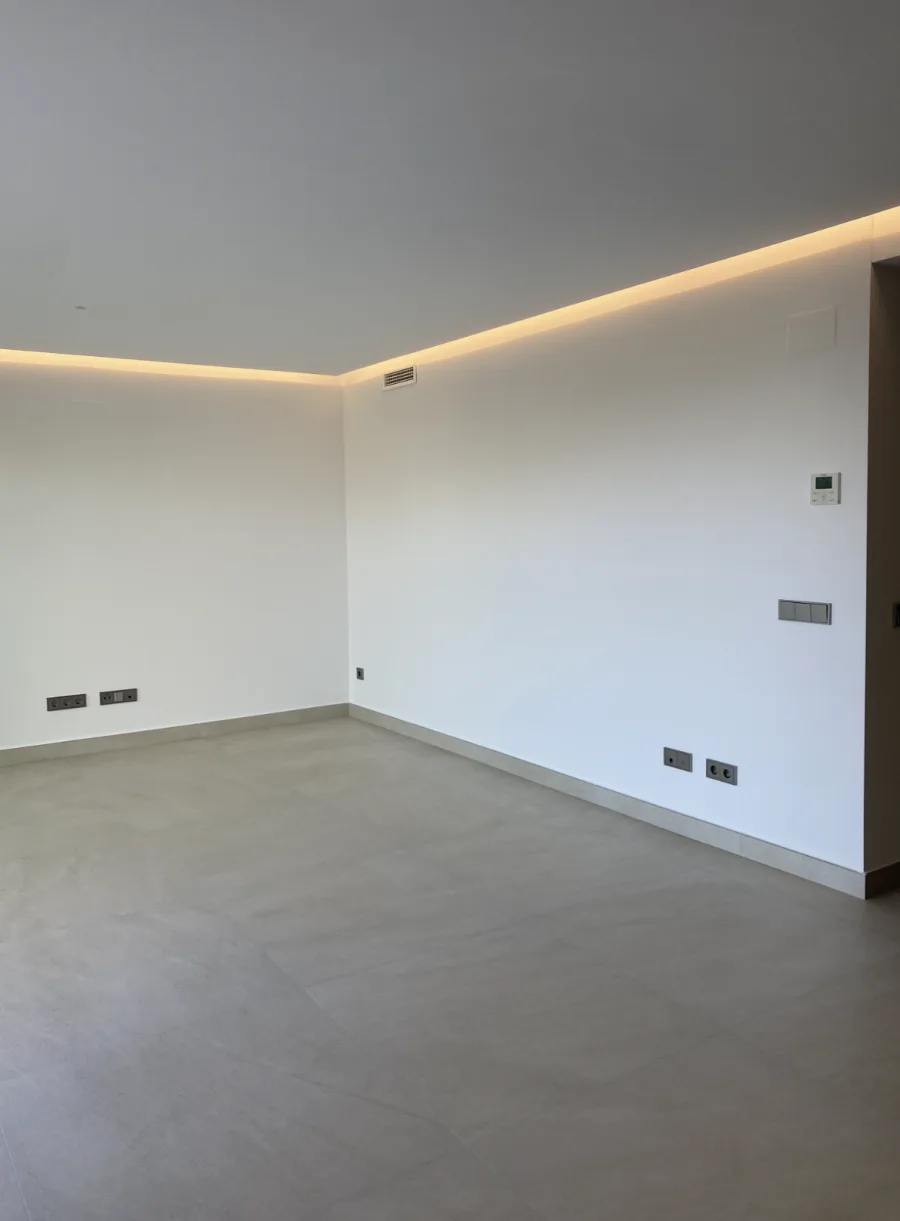 Perimeter cove LED lighting at the wall-ceiling junction; combined with microcement flooring and clean surfaces for a minimalist spatial effect.
Track Lighting Systems
A track lighting system consists of a metal rail connected to a single electrical circuit, onto which any number of adjustable spotlights can be mounted and repositioned at will. Combined with the soft backdrop of cove lighting, track spots handle task lighting: kitchen worktops, artwork, dining tables, and reading corners can all be lit with precision.
Rail Types
- Single-circuit (1-phase) rail: The most common and affordable option. All spots are on one circuit — controlled together by a switch or dimmer. Sufficient for single-zone rooms such as bedrooms and living rooms.
- 3-phase rail: Three independent circuits within a single rail body; different groups of spots can be switched independently. Favoured in open-plan kitchen-living areas or larger commercial settings.
- Magnetic track: Spots attach and detach via built-in magnets — no screwdriver needed. Repositioning takes seconds. Popular in retail, galleries, and flexible hospitality spaces.
Spot Fixture Selection
- Beam angle: Narrow (10°–20°) for artwork and product display; medium (25°–40°) for dining tables; wide flood (60°+) for general area coverage.
- Rotation: 350° horizontal and 90° tilt allows full directionality. A minimum 350° rotation is essential for gallery and boutique applications.
- Dim to warm (DTW): Spots that shift from cooler white to deep amber as they dim, mimicking candle and incandescent light. Popular in dining rooms and lounge areas.
Smart Lighting & Dimmer Control
The majority of LED gypsum ceiling projects now include a smart lighting system — driven by both energy savings and scene-programming flexibility.
Dimmer Compatibility
Not every LED strip or fixture works with every dimmer. Before purchasing, confirm:
- Is the LED driver dimmer-compatible? (Does it support 0–10V, DALI, or PWM dimming protocols?)
- Is the dimmer trailing-edge (for capacitive LED loads) or leading-edge (for inductive transformer loads)?
- Does the dimmer's minimum load match the low wattage of the LED strip? Mismatch causes flicker.
Smart Home Protocols
- Zigbee / Z-Wave / Matter: Low-energy mesh protocols that can manage hundreds of fixtures on a single network.
- DALI: Professional building-automation standard; each fixture receives an independent address. Used in Antalya's larger villas and boutique hotels.
- Tuya / Wi-Fi: Entry-level smart lighting, simple to install and controlled via mobile app — a cost-effective option for smaller properties.
Scene Programming
With scene control, a single tap or voice command can activate "Movie Night" — cove lights dim to warm amber, track spots off — or "Morning Breakfast" — track spots at full power in 4000K neutral white. This level of flexibility has become a standard expectation for short-term rental villas in Antalya targeting international guests.
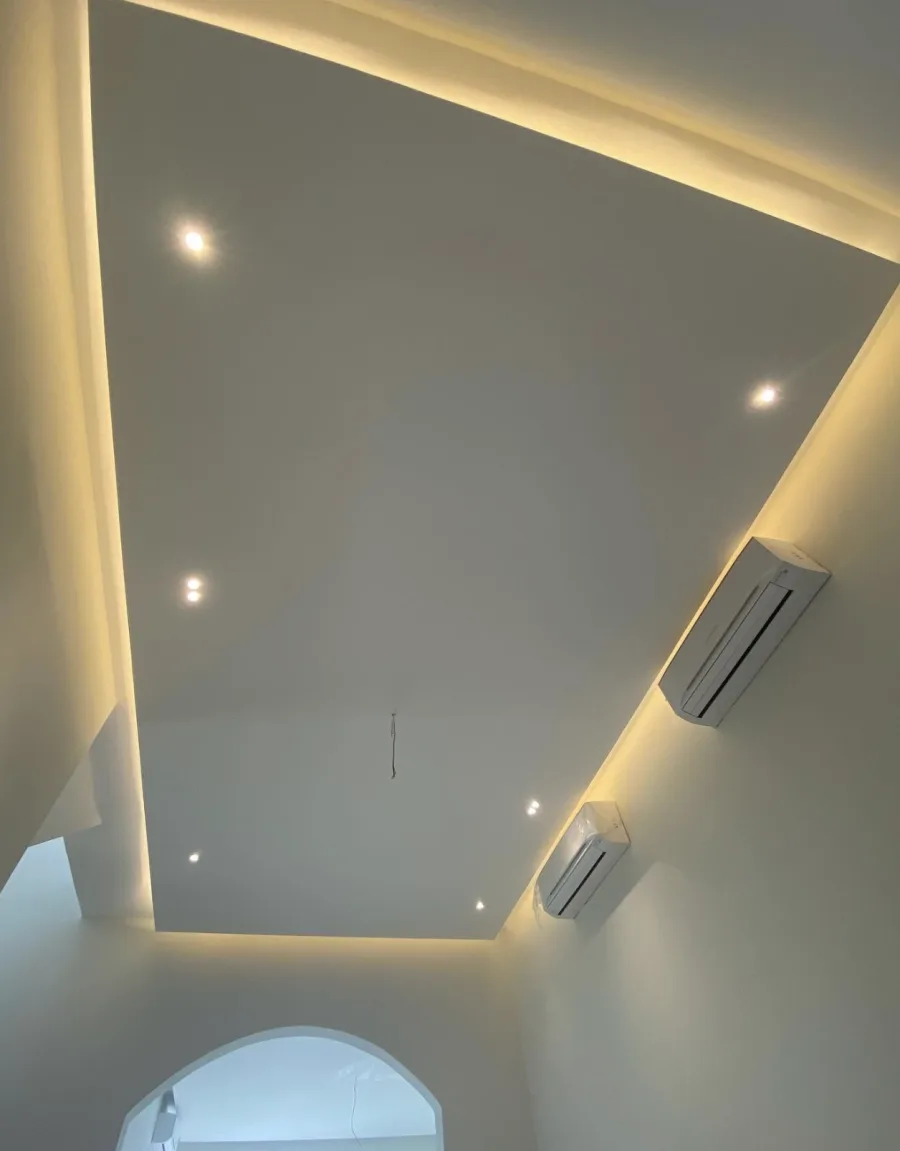 A multi-level gypsum ceiling with all-round LED cove lighting; a layered lighting design supported by recessed downlights.
LED Gypsum Ceiling Applications in Antalya
Gypsum ceiling installations in Antalya require specific local considerations:
- Humidity and temperature: Coastal humidity can cause condensation inside the ceiling void. Moisture-resistant plasterboard, a properly designed vapour barrier, and correct air-conditioner diffuser placement are non-negotiable.
- Summer heat and LED longevity: Ceiling void temperatures can exceed 50°C in summer. Quality aluminium profiles and high-grade drivers rated for elevated temperatures protect LED lifespan significantly; budget strips can fail within months under these conditions.
- Seismic suspension: Antalya sits in an active seismic zone. Standard hanger screws should be supplemented with seismic clips on ceiling suspension profiles for added safety.
- International rental market: Northern European and Russian tenants renting short-term villas in Antalya now expect smart lighting and dimmer control as standard. This feature measurably increases rental yield and guest satisfaction scores.
"An LED gypsum board ceiling is far more than an aesthetic upgrade — done correctly, it lowers energy bills, increases property value, and improves everyday quality of life. Working with a team that understands Antalya's specific climate and market makes this difference dramatically larger."
Ready to plan your LED gypsum ceiling in Antalya? Contact our team for a free on-site consultation — we cover everything from design concept to turnkey installation.